The color is the part of a siding project homeowners think about for months and most contractors cover in ten minutes. That is backwards. On a James Hardie job the finish decision is made before the order is placed, it is slow and expensive to reverse, and it carries a warranty that behaves nothing like the one covering the boards underneath it.
There are two ways to get color onto fiber cement. ColorPlus Technology is applied at the factory, before the product reaches your street. Primed product is painted on site, after it is on the wall. Both are legitimate. Most of the difference between them shows up in years three through fifteen, not on install day.
What ColorPlus actually is
ColorPlus is a factory-applied, oven-baked finish. That is Hardie's own description in its installation literature, where the coatings are baked onto the board rather than brushed onto it. The board arrives finished, under a protective laminate sheet. Nothing about the color happens on your property.
Hardie draws the contrast with field painting itself, and it is a fair one: field results depend on the paint, the painter and the weather that week. A factory line removes all three variables. Still, a manufacturer praising its own product is marketing until a document stands behind it. One does, and it is the warranty.
Two warranties, and they do not work the same way
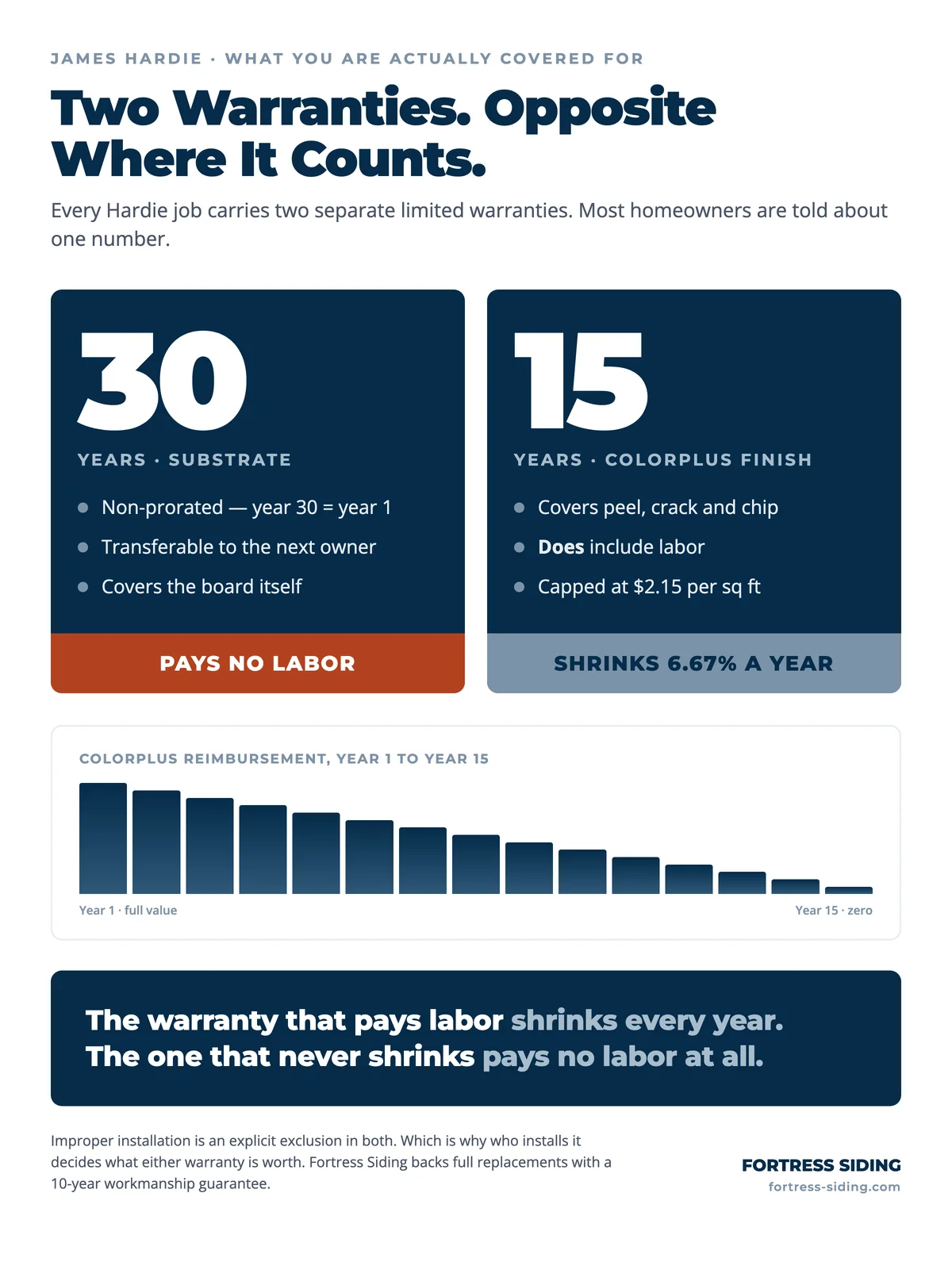
A Hardie job with ColorPlus carries two separate limited warranties, and they are opposites in the two ways that matter most.
The substrate warranty runs 30 years. It covers the board: compliance with ASTM C1186, freedom from manufacturing defects, and damage from hail, woodpeckers and termites. It is non-prorated, so the benefit in year 30 equals the benefit in year 1 — a refund, a replacement, or up to twice the defective portion's original retail cost. Then there is this, in capitals in the document: “JAMES HARDIE WILL NOT REFUND OR PAY ANY COSTS IN CONNECTION WITH LABOR OR ACCESSORY MATERIALS.” Thirty years of material coverage, zero labor.
The ColorPlus finish warranty runs 15 years and warrants that the finish will not peel, crack or chip. It does include labor. And it is prorated — Hardie's own product catalog uses that word. Full paint-and-labor reimbursement, capped at $2.15 per square foot, applies in the first year only. From year 2 through year 15 the payment is reduced by 6.67 percent per year until it reaches zero.
So the warranty that pays labor is the one that shrinks every year, and the one that never shrinks pays no labor at all. Anyone who tells you the finish is covered for paint and labor for 15 years is repeating a line the warranty document contradicts.
Four more provisions decide real claims:
- Fading is not covered. The finish warranty expressly excludes fading and chalking from normal weathering. What it covers is excess color change, defined as more than four delta E units within the first three years after install. Hardie publishes no plain-English translation of four delta E, and we will not invent one. ColorPlus is fade-resistant, not fade-proof.
- Both warranties transfer exactly once. Coverage extends to the first retail purchaser, the first owner of the structure, and the first transferee. Not to every future owner.
- Improper installation is an explicit exclusion in both — including failure to follow Hardie's published instructions and applicable building codes. In Pennsylvania that means the HZ5 clearances: minimum 2 inches where siding meets roofs, decks, slabs, paths and steps, 6 inches to grade. The finish you paid extra for does not survive an installation that ignores them. The rest of that system is in our piece on choosing siding materials.
- Third-party coatings are excluded in both. The exclusion names “peeling or performance of any third party paints, stains and/or coatings.” Whatever a painter puts on the wall sits outside Hardie's coverage.
The field-painted path, done properly
Primed Hardie is not a lesser product, and Hardie expects it to be painted. The instruction is specific: primed product must be painted within 180 days, unprimed within 90. Hardie does not publish a sentence saying that missing those windows voids coverage, and we will not put words in its mouth. What it does publish is the exclusion above for failure to follow its installation instructions.
The paint spec is short. One hundred percent acrylic topcoats are recommended. No stain, no oil or alkyd base paint, no powder coating, and do not paint when wet. Back-roll if it is sprayed. We do not stain Hardie and nobody else should either — that is a prohibition in the manufacturer's own installation document.
Field painting buys range and reversibility: any color a paint store can mix. It costs you the 15-year finish warranty, because there is no ColorPlus finish to warrant; the 30-year substrate coverage is unaffected. It also adds a painting scope with its own weather window, narrower in a Lancaster or Cumberland County October than people expect. If a bid puts field painting on a house in late fall, ask when it is scheduled and what happens if it does not fit. Our piece on cold-weather installation covers which parts of a job the calendar governs.
Touch-up, caulk and the details that give a job away
James Hardie touch-up kits are required to touch up ColorPlus products. A painter's color-matched quart is not an approved substitute. Hardie states it does not warrant third-party touch-up on ColorPlus, and that appearance or performance problems from it are not covered under the finish warranty. A Hardie touch-up notice gives the reason in measurable terms rather than as taste: poor color match at or shortly after install, and heavy chalking, showing as soon as one year in. That notice is undated and distributor-hosted, so we grade it below the warranty documents. The requirement itself is in the installation instructions.
Touch-up is for nicks, scrapes and nail heads only, used sparingly. Hardie's instruction for a large damaged area is not to paint it but to replace the plank. Edge coaters and touch-up pens carry a harder limit still: nothing larger than a dime. A wall with broad brushed-in patches was repaired the wrong way, and it will read differently from the factory finish within a year or two.
Caulk is mostly the wrong answer on ColorPlus. Do not caulk nail heads — Hardie prohibits it, and gives the reason plainly: the caulk and the ColorPlus weather differently, so a wall that looks uniform on handover day develops a visible pattern of dots as the two surfaces age apart. Hardie does not recommend caulk at field butt joints either. Joint treatment — the flashing behind the joint — is required for ColorPlus and recommended for primed product, and factory-finished edges go in together in moderate contact. Caulk belongs in one place: where a non-factory cut edge terminates into trim, using color-matched caulk from the ColorPlus dealer, with edge coaters elsewhere. And the protective laminate sheet must come off immediately after each course is installed; planks left overnight with the film still on is a small thing that suggests larger ones.
Touch-up has a temperature rule, and it is a scheduling item. The kit label reads that touch-up should be applied when the temperature of the air and the siding products is above 40°F, and that the material must not freeze. That is a rule about the temperature of the board, not the thermometer on the porch; a stack that sat out overnight is still cold at two in the afternoon on a 45°F day. The honest complication: a James Hardie notice says Hardie has lowered the cold-climate recommendation to 35°F or above and is relabeling. That notice is undated and conflicts with kits in circulation, so read the label on your own job rather than trusting one confident number from anyone, us included. Storage is firmer: kits between 40°F and 100°F, never frozen. A kit left in a truck through a Carlisle or Lebanon January is not a kit any more. None of this governs the siding itself: Hardie publishes no minimum installation temperature. The boards go on in the cold. Touch-up is the piece staged around the weather.
What low maintenance means in year eight
Hardie's published homeowner maintenance is to wash the exterior every 6 to 12 months with a garden hose and a soft brush or wet cloth. Acid washing and high-pressure washing are specifically not recommended and can damage the fiber cement surface. Lack of proper maintenance is a warranty exclusion, which makes that rinse a condition rather than advice. A pressure washer set high enough to strip algae off a north wall is doing damage Hardie told you not to do, and that damage is not covered. When paint does chip or crack, on ColorPlus or field-painted walls alike, Hardie says to remove it, clean the surface and repaint immediately with a good quality 100 percent acrylic.
And the horizon is real: the finish warranty ends at 15 years. ColorPlus is a durable finish in a climate that is hard on coatings. It is not permanent, and anyone selling it that way is overselling a good product.
Changing the color later
You can repaint ColorPlus. Hardie permits it and publishes the prep: surface clean, dry and free of dust, dirt or mildew; repriming normally not necessary; 100 percent acrylic topcoats. Its own FAQ says siding can be repainted if you choose to change colors after installation.
What you will read elsewhere is that repainting voids the 15-year warranty. Hardie publishes no such statement. The accurate, narrower version: the new coating is not Hardie's and is not covered by Hardie. The factory finish underneath is not retroactively disowned. The paint on top of it was never insured.
It is still a long decision. In a market where most full James Hardie projects run $25,000 to $45,000 depending on size, trim detail and tear-off, repainting the whole wall is not a casual change. If you expect to want a different color in five years, buy primed and field-paint it.
Plan for one more thing either way. Hardie reserves the right to discontinue or modify any product at any time without notice, and the Statement Collection is explicitly regional. There is no published color retirement schedule, and we will not name colors we cannot source-check. So order a few extra planks at the time of the job and store them the way Hardie stores everything — flat, covered, off the ground, dry. A repair matched from stock beats one matched from memory.
Why a color looks different on your wall than on the sample
Almost every color regret we hear traces back to a decision made from something small held in a hand. Three things change between the two.
Area. A chip is a few square inches; your walls are measured in squares. The same pigment reads lighter and more saturated across a large surface, so colors chosen at chip scale land stronger than intended.
Shadow. Lap siding is not flat. Every course casts a line of shadow on the one below it, all day, so a lapped wall reads darker and cooler than the flat board the color was picked from. Panel and batten in a gable reads differently again, which is why a field color and a gable accent that looked right on a counter can fight on the house.
Light and orientation. A north elevation gets no direct sun through the middle of the day, in any season. It is lit by sky light, which is cooler and bluer. Grays that look warm on the south wall go blue on the north wall of the same house. Tree canopy adds a green cast, which matters on wooded lots in Chester and Berks County.
So get an actual ColorPlus sample board, not a printed chip. Hold it vertically against the wall it will go on. Look at it north and south, morning, midday and late afternoon, once on a gray day, and next to the roof and any stone or brick you are keeping. We will not tell you dark colors fade faster, because Hardie publishes no fade-rate data by color and we have no document to hand you.
Trim, accents and a palette you can live with
The mistake people make with trim is almost never the hue. It is the amount of contrast. A crisp white or near-white trim against a mid-tone field is the combination homeowners tire of last. Heavy contrast reads as a statement, and statements date. That is a judgment, not a specification.
Two practical rules come from the installation side. Design so cut edges land in trim — Hardie's instruction is to terminate non-factory cut edges into trim where possible and caulk them, so generous corner boards are not only a look, they are where the cuts belong. And keep accents on what you can change cheaply. A front door and shutters are a weekend and a gallon. A field color is a factory order and a crew.
Availability differs between the two ColorPlus offerings, and it affects more than looks. Hardie describes the Statement Collection as curated and locally stocked, and says the offering differs per region. The Dream Collection is nearly 700 finishes, made to order, and Hardie says that Dream products may incur additional cost and lead time. A Dream color is a scheduling and future-repair decision as much as an aesthetic one. Settle it early, because it sits in front of the order, and good crews book ahead seasonally — the subject of our piece on crew availability.
And choose against the roof, which on most homes is the largest single area of color. If a roof replacement is also in the plan, pick both at once rather than matching siding to a roof you are about to tear off.
When we would tell you not to order yet
- You have not seen a real board on the actual wall. Not a chip, not a rendering, not a neighbor's house two towns over in different light.
- You are choosing for a sale next year. The warranties transfer once, and a color picked for a buyer who does not exist yet is a decision made for someone else.
- You want the option to change it in five years. Then ColorPlus is the wrong product for you. Buy primed, field-paint with 100 percent acrylic inside the 180-day window, and accept that the finish is yours to maintain. That is a legitimate choice, and we would rather you make it on purpose than discover it later.
And if the material itself is still open, start upstream, with James Hardie versus vinyl siding on Pennsylvania homes.
Fortress Siding installs James Hardie fiber cement and premium vinyl siding, roofing, replacement windows, seamless gutters and fascia and soffit across Lancaster, York, Adams, Cumberland, Dauphin, Lebanon, Berks and Chester Counties. We are a James Hardie Contractor Alliance member, and we carry a 10-year workmanship guarantee on full replacements.